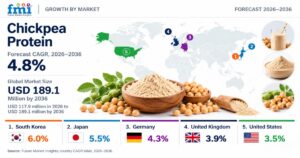

The global chickpea protein market is projected to grow from USD 117.9 million in 2026 to USD 189.1 million by 2036, registering a compound annual growth rate (CAGR) of 4.8%, according to Future Market Insights (FMI). The forecast represents an incremental market opportunity of USD 71.2 million over the period.
Get detailed market forecasts, competitive benchmarking, and pricing trends:
https://www.futuremarketinsights.com/reports/sample/rep-gb-12547
Demand is supported by food manufacturers seeking additional protein ingredients for formulated foods, bakery products, beverages and meat alternatives. However, expanding commercial use depends on more than protein concentration. Ingredient suppliers must deliver consistent flavor, solubility and dispersion under the processing conditions used by food manufacturers.
Food-tech investment supports demand, while formulation remains a constraint
Manufacturing infrastructure and application development are helping create opportunities for alternative protein ingredients. In July 2026, South Korea’s Ministry of Agriculture, Food and Rural Affairs (MAFRA) stated that food smart-factory participation would increase from 30 facilities in 2024 to 187 by 2026. The development points to a broader manufacturing base for food-tech projects and gives ingredient developers additional potential routes for application trials.
The commercial challenge is ensuring that chickpea protein performs consistently in finished products. Differences in chickpea varieties and extraction methods can affect flavor and solubility, increasing the time required for product qualification. Manufacturers must also consider whether additional masking or stabilization work will offset the economic benefit of using the ingredient.
Where growth is fastest
FMI’s country-level forecasts show stronger projected growth in East Asia than in the other profiled markets. The following rates cover 2026 to 2036.
- South Korea — 6.0% CAGR: Food-tech commercialization networks connect developers with manufacturers, investors and retailers, supporting opportunities to move alternative protein concepts into product trials.
- Japan — 5.5% CAGR: Established experience with plant proteins and organized food-tech collaboration provide routes for development, although local taste and texture expectations remain important.
- Germany — 4.3% CAGR: Regional protein value-chain initiatives and an established plant-based food industry support interest in alternative ingredients, while cost and formulation performance remain key purchasing considerations.
- United Kingdom — 3.9% CAGR: Familiarity with plant-based alternatives provides opportunities for new protein ingredients, but price, flavor and retail acceptance influence adoption.
- United States — 3.5% CAGR: Domestic chickpea availability and established food-ingredient manufacturing support demand, although extraction economics and the distance between farms and processing facilities affect commercial viability.
The country forecasts indicate different growth rates, not the absolute size of each national market. Manufacturers evaluating expansion opportunities should also consider customer demand, ingredient supply and the technical requirements of their target applications.
What leads the market
Three segments account for substantial projected shares of the global chickpea protein market in 2026, according to FMI.
- Protein isolates — 45.3%: Higher protein concentration gives formulators greater control over the protein content of finished products. Dispersion and sensory performance must still meet application-specific requirements.
- Conventional chickpea protein — 95.0%: Broader crop availability and fewer certification requirements support its position in mainstream commercial applications.
- Food processing — 47.8%: Use across multiple manufactured-food applications supports this end-use segment, including formulations where protein content, texture and processing performance must be managed together.
These shares reflect different dimensions of the market: product type, nature and end use. They should not be added together as if they represented mutually exclusive portions of one category.
The hurdle: consistent performance at commercial scale
The main restraint is variability in ingredient performance. Differences in cultivar and extraction conditions can affect flavor and solubility, creating additional work for product-development and manufacturing teams.
A protein ingredient that meets a nutritional specification may still require flavor masking, stabilization or process adjustments before it can be used reliably in a finished product. These requirements can extend qualification timelines and increase the total cost of formulation.
FMI identifies application-specific testing as an opportunity for suppliers and food manufacturers. Trials designed around the intended product and manufacturing process can help identify suitable ingredient grades earlier and reduce avoidable reformulation work.
Industry investment and recent developments
Recent developments in the wider plant-protein and food-ingredient sector illustrate the focus on manufacturing capacity, application performance and formulation support.
- February 2025: Burcon NutraScience Corporation agreed with RE ProMan on a North American protein production facility intended to provide Burcon with exclusive manufacturing access for its plant-protein portfolio.
- September 2025: Kerry Group plc opened a biotechnology centre in Leipzig focused on enzyme and fermentation development and bioprocess work for food formulation.
- 2026: ADM continued commercializing its AccelFlex™ TS PC70 plant-protein solution, a pea-and-chickpea protein blend designed for meat alternatives and meat-extension applications.
These developments concern broader plant-protein and food-ingredient capabilities; they should not be interpreted as evidence that each company has launched a new standalone chickpea protein product.
FMI identifies the following companies among the notable participants in the chickpea protein market:
Roquette Frères, ADM, Ingredion Incorporated, Cargill Incorporated, Kerry Group plc, The Scoular Company, Burcon NutraScience Corporation, and AGT Food and Ingredients Inc.
Analyst perspective
“Chickpea protein economics are settled during formulation trials because masking and line adjustments can erase a lower ingredient price. Repeat volume follows grades that hold flavor and dispersion targets without forcing extra stabilization during normal production.” — Nandini Roy Choudhury, Principal Consultant, Future Market Insights.
What this means for food and beverage manufacturers
- Qualify ingredients against the finished product, not protein content alone. Test flavor, solubility, dispersion and texture under actual processing conditions. A grade that performs well in one application may need additional qualification for a different product.
- Compare total formulation cost before changing protein sources. Include flavor masking, stabilization, process adjustments and reformulation time when evaluating ingredient prices. A lower purchase price may not translate into a lower finished-product cost.
- Match sourcing and market-entry plans to commercial requirements. Assess crop availability, supplier consistency and application support before committing to larger production runs. Manufacturers targeting South Korea or Japan should also account for local product preferences and the availability of technical partners.
For detailed forecasts, segment analysis, country-level growth rates and competitive coverage, read FMI’s Chickpea Protein Market Size, Share, Trends 2036 Report:
https://www.futuremarketinsights.com/reports/chickpea-protein-market
Explore More Research Reports by FMI
Cardiometabolic Protein Nutrition Market –
https://www.futuremarketinsights.com/reports/cardiometabolic-protein-nutrition-market
Texturized Vegetable Protein Market –
https://www.futuremarketinsights.com/reports/texturized-vegetable-protein-market
Dietary Fibers & Prebiotic Fiber Market –
https://www.newstrail.com/dietary-fibers-prebiotic-fiber-market/
About Future Market Insights (FMI)
Future Market Insights, Inc. (FMI) is an ESOMAR-certified, ISO 9001:2015 market research and consulting organization, trusted by Fortune 500 clients and global enterprises. With operations in the U.S., UK, India, and Dubai, FMI provides data-backed insights and strategic intelligence across 30+ industries and 1200 markets worldwide.
For Press & Corporate Inquiries
Rahul Singh AVP – Marketing and Growth Strategy
Future Market Insights, Inc.
+91 8600020075
For Sales: sales@futuremarketinsights.com
For Media: Rahul.singh@futuremarketinsights.com
For Web: https://www.futuremarketinsights.com/