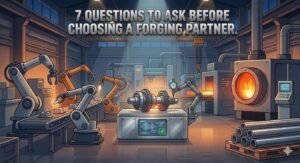

Selecting the right forging partner is not just a procurement decision—it’s a strategic choice that directly impacts product performance, reliability, and long-term success. In industries like aerospace, oil & gas, power generation, and heavy engineering, even a minor compromise in forging quality can lead to significant operational risks.
To ensure you choose a partner who meets both technical and business expectations, here are seven critical questions you should ask:
1. Do You Have the Capacity for Large-Scale Seamless Rolled Rings?
Not all forging manufacturers are equipped to handle large-scale or specialized components. If your application requires high-strength circular parts, it’s essential to confirm whether the supplier specializes in Seamless Rolled Rings.
Unlike welded rings, seamless rolled rings are forged from a single piece of metal, offering superior strength, structural integrity, and fatigue resistance. Always ask about their maximum diameter, weight capacity, and production capabilities to ensure they can scale as your project grows.
2. What Is Your Approach to Material Traceability?
In modern manufacturing, traceability is not optional—it’s critical. A reliable forging partner should have a robust system in place to track materials from raw input to final delivery.
Look for companies using advanced ERP systems like Microsoft Business Central, which ensure complete visibility across the production lifecycle.
Follow-up question:
How long are compliance records maintained?
Top-tier manufacturers often retain records for 20–30 years, ensuring accountability and audit readiness.
3. How Do You Handle Complex Alloys like Titanium and Aluminum?
Forging standard carbon steel is one thing, but working with advanced alloys such as titanium and aluminum requires specialized expertise.
These materials demand precise temperature control, advanced forging techniques, and dedicated infrastructure. A lack of experience can result in internal defects, poor grain structure, and compromised component performance.
Make sure your partner has proven experience and case studies in handling high-performance alloys.
4. What In-House Testing Capabilities Do You Offer?
Quality assurance should never be outsourced entirely. A dependable forging partner must offer in-house Non-Destructive Testing (NDT) to ensure product integrity.
Key testing methods to look for include:
- Ultrasonic Testing (UT)
- Magnetic Particle Inspection (MPI)
- Liquid Penetrant Testing (LPT)
Having these capabilities in-house ensures faster turnaround, better quality control, and a “zero-defect” delivery approach.
5. Is Your Manufacturing Process Sustainable?
Sustainability is no longer just a corporate responsibility—it’s a competitive advantage. Businesses today are expected to align with environmentally responsible practices.
Ask your forging partner about their energy sources, waste management systems, and emission control practices. Manufacturers that utilize renewable energy or energy-efficient technologies not only reduce environmental impact but also demonstrate long-term operational responsibility.
6. Can You Handle Precision Machining Post-Forging?
While near-net-shape forging reduces material waste, most components still require precision machining before installation.
Choosing a partner that offers integrated machining services eliminates the need for multiple vendors. This results in:
- Reduced logistics costs
- Faster delivery timelines
- Lower risk of handling damage
An end-to-end solution provider ensures consistency and efficiency throughout the production cycle.
7. What Is Your Track Record with International Standards?
If your business operates globally, compliance with international standards is essential. Your forging partner should hold certifications such as:
- ISO 9001 (Quality Management)
- AS 9100 (Aerospace Standards)
- PED (Pressure Equipment Directive)
A company with a long-standing legacy and decades of experience typically has the systems, processes, and expertise required to meet stringent global requirements.
The Bottom Line
Choosing a forging partner goes beyond comparing prices—it’s about evaluating capability, reliability, and long-term value. By asking these seven questions, you shift from simply sourcing components to building a strategic manufacturing partnership.
The right partner will not only meet your current requirements but also support your future growth with advanced technology, proven expertise, and a commitment to quality.
Ready to take the next step?
Explore our capabilities or connect with our engineering team to discuss your next project.