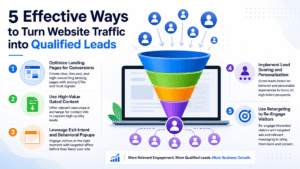

Driving traffic to your website is an important milestone—but it’s only the beginning. Many businesses invest heavily in SEO, paid ads, and social media campaigns to attract visitors, yet struggle to convert that traffic into meaningful leads. The real value lies not in how many people visit your site, but in how many of those visitors take action.
Turning website traffic into qualified leads requires a strategic combination of user experience, content, targeting, and data-driven optimization. Below are five proven techniques that can help you transform casual visitors into high-intent prospects.
1. Optimize Landing Pages for Conversions
Your landing pages are often the first impression visitors have of your business. A poorly designed or cluttered page can drive potential leads away instantly. To improve conversions, your landing pages must be clear, focused, and action-oriented.
Start with a compelling headline that communicates value immediately. Visitors should understand what you’re offering within seconds. Follow this with concise, benefit-driven copy that addresses their pain points. Use strong calls-to-action (CTAs) such as “Download Now,” “Get a Free Demo,” or “Start Your Trial.”
Design also plays a critical role. Clean layouts, fast loading speeds, and mobile responsiveness are essential. Adding trust signals—such as testimonials, client logos, and security badges—can further increase credibility and encourage conversions.
2. Use High-Value Gated Content
One of the most effective ways to capture leads is by offering valuable content in exchange for contact information. This is commonly known as gated content. Examples include eBooks, whitepapers, industry reports, webinars, and case studies.
The key is relevance. Your content must align with the needs and interests of your target audience. For instance, a B2B cybersecurity firm might offer a detailed threat intelligence report, while a SaaS company could provide a product comparison guide.
Keep your forms simple—asking for too much information can discourage users. Typically, a name, email, and company name are enough to get started. Once the lead is captured, you can use follow-up campaigns to gather additional details over time.
3. Leverage Exit-Intent and Behavioral Popups
Not every visitor is ready to convert on their first visit. However, that doesn’t mean the opportunity is lost. Exit-intent and behavioral popups can help capture leads just before users leave your site.
Exit-intent popups detect when a user is about to close the tab or navigate away, triggering a targeted message. This could be a discount offer, a free resource, or a newsletter subscription.
Behavioral popups, on the other hand, are triggered based on user actions—such as time spent on a page, scroll depth, or pages visited. These popups allow you to present relevant offers at the right moment, increasing the chances of engagement.
When implemented correctly, popups can significantly boost lead generation without disrupting the user experience. The key is to keep them non-intrusive, visually appealing, and highly relevant.
4. Implement Lead Scoring and Personalization
Not all leads are created equal. Some visitors are just browsing, while others are actively looking for solutions. Lead scoring helps you identify and prioritize high-quality prospects based on their behavior and engagement.
For example, a visitor who downloads multiple resources, visits pricing pages, or spends significant time on your site is likely more interested than someone who leaves after a few seconds. By assigning scores to these actions, you can segment your audience and focus on the most promising leads.
Personalization takes this a step further. By tailoring content, offers, and messaging based on user behavior, industry, or demographics, you can create a more relevant and engaging experience.
For instance, returning visitors could see personalized recommendations, while first-time users might receive introductory content. This level of customization increases engagement and improves conversion rates.
5. Use Retargeting to Re-Engage Visitors
A large percentage of website visitors leave without taking any action. Retargeting allows you to reconnect with these users through targeted ads across platforms like search engines and social media.
By placing tracking pixels on your website, you can identify visitors and serve them relevant ads based on their previous interactions. For example, someone who visited your product page might see an ad highlighting key features or customer success stories.
Retargeting keeps your brand top-of-mind and encourages users to return and complete their journey. It is especially effective when combined with strong offers, such as limited-time discounts or exclusive content.
To maximize results, segment your audience based on behavior and tailor your messaging accordingly. This ensures that your ads remain relevant and compelling.
Final Thoughts
Generating website traffic is only half the equation—converting that traffic into qualified leads is where real growth happens. By optimizing landing pages, offering valuable gated content, using smart popups, implementing lead scoring, and leveraging retargeting, businesses can significantly improve their conversion rates.
The most successful strategies are those that prioritize user experience and deliver value at every stage of the customer journey. Instead of focusing solely on increasing traffic, shift your attention to understanding your audience, addressing their needs, and guiding them toward meaningful action.
In a digital environment where attention spans are short and competition is high, a well-executed lead generation strategy can be the difference between missed opportunities and sustained business growth.
Read More: https://intentamplify.com/blog/three-techniques-for-generating-leads/