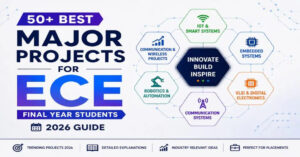

Choosing the right project can shape your final semester, your resume, and even your first job offer. This guide lists 40 practical Major Projects for ECE Final Year Students across IoT, communication, VLSI, signal processing, robotics, and power electronics. Many ideas also work as a final year project for electrical engineering because they combine hardware, software, and power systems. Each entry has a short explanation so you can shortlist quickly.
Embedded and IoT: Major Projects for ECE Final Year Students
- Smart Home Automation: An ESP32 or Arduino controls lights, fans, and appliances through a mobile app or voice assistant, with sensors adding automatic responses to temperature and occupancy.
- IoT Smart Agriculture Monitor: Soil moisture, temperature, and humidity sensors send data to the cloud, and a pump switches on automatically when crops need water.
- Wearable Health Monitor: A pulse sensor measures heart rate, SpO2, and body temperature, then transmits readings over Bluetooth or Wi-Fi to a doctor’s dashboard.
- RFID Attendance System: Students tap RFID cards, a microcontroller logs each entry, and software generates attendance reports without manual roll calls or proxies.
- Smart Parking System: Ultrasonic or IR sensors detect free slots and show availability on an LED board or app, saving drivers time and fuel.
- Smart Street Light System: LDR and motion sensors dim or brighten streetlights according to daylight and traffic, cutting electricity use on empty roads.
- Air Quality Monitoring Station: Gas sensors measure CO2, PM2.5, and other pollutants, then upload readings to a live dashboard with alerts for unhealthy levels.
- Smart Waste Management Bin: Ultrasonic sensors detect when a dustbin is full and notify collectors, helping municipalities plan efficient pickup routes.
Communication: Major Projects for ECE Final Year Students
- LoRa Long-Range Network: Builds a low-power wireless link covering several kilometres, ideal for rural sensors, campus monitoring, and disaster-area messaging.
- Li-Fi Data Transmission: Sends data through modulated LED light instead of radio waves, demonstrating a fast, interference-free alternative for short-range links.
- Software Defined Radio Receiver: An RTL-SDR dongle with GNU Radio receives and demodulates FM, weather, and aircraft signals entirely in software.
- Microstrip Patch Antenna Design: Design and simulate a compact antenna in HFSS or CST for Wi-Fi or 5G bands, then fabricate it and measure gain and return loss.
- GSM-GPS Vehicle Tracking: Combines a GPS module with GSM to send live location by SMS or map dashboard, useful for fleet security and theft recovery.
- Zigbee Wireless Sensor Network: Several nodes form a mesh that relays sensor data to a base station, showing low-power networking for factories and farms.
- OFDM Transceiver Simulation: Implements modulation, IFFT, channel effects, and demodulation in MATLAB, then compares bit error rates across noise levels.
- Massive MIMO Channel Estimation: Simulates multi-antenna systems and tests estimation algorithms, giving hands-on exposure to core 5G concepts.
VLSI and Digital Design: Major Projects for ECE Final Year Students
- 8-bit RISC Processor on FPGA: Design the instruction set, ALU, and control unit in Verilog, then run sample programs on an FPGA board.
- Low-Power SRAM Cell: Create a 6T or 8T cell in Cadence and optimise power, delay, and stability at smaller technology nodes.
- UART Controller in Verilog: Implements transmitter, receiver, and baud rate generator, verified through simulation and tested on hardware.
- Neural Network Accelerator: Builds a small FPGA unit that speeds up matrix multiplication, enabling efficient AI inference on edge devices.
- Digital Clock with Alarm: Uses counters, state machines, and display drivers. It is beginner-friendly and easy to demonstrate in a viva.
- Vedic Multiplier Design: Applies ancient Vedic mathematics to build a faster, lower-power multiplier, compared against conventional array designs.
- Traffic Light Controller: A finite state machine manages signal timing for a junction, with pedestrian and emergency modes added for extra depth.
- FIR Filter on FPGA: Implements a pipelined digital filter in hardware and compares speed and resource usage against software versions.
Signal and Image Processing: Major Projects for ECE Final Year Students
- ECG Arrhythmia Detection: Filters noise from ECG recordings and uses machine learning on extracted features to flag irregular heartbeats.
- Face Recognition Attendance: OpenCV and deep learning identify faces through a camera and mark attendance without physical contact.
- Speech Recognition Voice Control: Converts spoken commands into actions using MFCC features and a classifier, enabling hands-free device control.
- Drowsy Driver Detection: A camera tracks eye closure and yawning, triggering a buzzer to warn tired drivers before accidents happen.
- Number Plate Recognition: Detects vehicles, segments plates, and reads characters with OCR for toll booths, parking lots, and campus gates.
- Brain Tumor Detection from MRI: Preprocesses scans, segments suspicious regions, and classifies them, with accuracy compared across several algorithms.
Robotics and Automation: Major Projects for ECE Final Year Students
- Line Follower and Obstacle Avoiding Robot: IR and ultrasonic sensors with PID control give smooth navigation, forming the base for warehouse robots.
- Gesture-Controlled Robotic Arm: Accelerometer or camera gestures drive servo motors, useful for assistive tasks and handling hazardous objects remotely.
- Autonomous Surveillance Drone: A flight controller, GPS, and camera follow waypoints and stream live video for security and mapping.
- Fire Fighting Robot: Flame sensors guide a mobile robot toward the fire, where a pump or fan extinguishes it without risking human lives.
- Voice-Controlled Wheelchair: Lets users with disabilities steer a motorised wheelchair by speaking, with obstacle detection to stop it safely.
Power Electronics and Renewable Energy: Final Year Project for Electrical Engineering Ideas
- Solar Tracker with MPPT: Rotates panels toward the sun and applies maximum power point tracking to raise energy output. It is a classic final year project for electrical engineering students.
- Smart Energy Meter with IoT: Measures consumption in real time, uploads it to a dashboard, and alerts users about high usage or electricity theft.
- EV Battery Management System: Monitors voltage, current, temperature, and charge level to protect cells from overcharge and imbalance, making it a strong final year project for electrical engineering departments.
- Wireless Power Transfer: Charges small devices through resonant inductive coupling, showing how efficiency changes with distance and alignment.
- Grid-Tied Inverter Design: Converts solar DC into synchronised AC, covering PWM control, output filtering, and grid protection, which also suits any final year project for electrical engineering syllabus.
How to Choose Among Major Projects for ECE Final Year Students
Pick a topic that matches your interest, budget, mentor expertise, and available time. Prefer ideas with measurable outcomes, such as accuracy achieved, power saved, or range extended. The best Major Projects for ECE Final Year Students combine hardware, simulation, and a working demo. If your department also accepts a final year project for electrical engineering, start with the power electronics list above.
FAQs on Major Projects for ECE Final Year Students
Q1. What are the best Major Projects for ECE Final Year Students?
Projects that blend hardware and software, such as IoT systems, FPGA designs, and robotics, are best because they show practical skills recruiters value.
Q2. How do I choose the right project topic?
Match your interests, budget, and mentor expertise. Check component availability and prefer ideas with measurable results.
Q3. Can ECE ideas work as a final year project for electrical engineering?
Yes. Topics like smart meters, solar trackers, and battery management systems suit both ECE and electrical branches.
Q4. How long does a major project take?
Usually four to six months, including literature review, design, testing, and documentation. Start planning in the previous semester.
Q5. Are these Major Projects for ECE Final Year Students suitable for beginners?
Yes. Begin with simpler options like RFID attendance or a line follower robot, then add features to increase complexity.
Q6. Which software tools should I learn?
It depends on the domain. Common tools include Arduino IDE, MATLAB, Python with OpenCV, Proteus, Xilinx Vivado, Cadence, and HFSS.
Q7. How much does a project cost?
Most embedded and IoT builds are affordable, while drones, FPGA boards, and antenna fabrication cost more. Plan your budget before buying components.
Q8. Can I publish my project as a research paper?
Yes. Projects with novel improvements and measured results can be submitted to student conferences or journals with your guide’s support.
Q9. Where can I get help with Major Projects for ECE Final Year Students?
Start with your guide, lab staff, open-source communities, GitHub repositories, and component datasheets before approaching external mentors.
Q10. What makes a project stand out in viva?
A clear problem statement, a working demo, proper test data, and an honest explanation of limitations and future improvements.
Conclusion
Whichever topic you pick from these Major Projects for ECE Final Year Students, focus on clear objectives, proper testing, and a clean report. Start early, document every stage, and prepare a live demo. With the right choice, these Major Projects for ECE Final Year Students can strengthen your portfolio, and a well-built final year project for electrical engineering can open doors in core industries too.