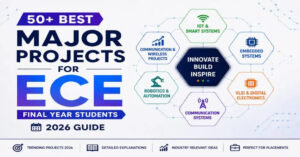

Choosing from the right list of Major Projects for ECE Final Year Students can make the difference between a rushed, forgettable submission and a project that genuinely demonstrates your technical ability. Electronics and Communication Engineering is a broad field, covering everything from embedded systems and VLSI to communication networks and robotics, which means students often have dozens of possible directions to choose from — but not all of them are equally practical, well-documented, or resume-worthy.
This guide walks through 30 well-rounded project ideas, each explained in enough detail to help you understand what it involves, what skills it builds, and why it might suit your final year submission. A few of these also work well as a final year project for electrical engineering students, since ECE and EEE share overlapping fundamentals in circuits, power systems, and embedded control.
How to Choose the Right Major Projects for ECE Final Year Students
Before diving into the list, it helps to think about three things: your comfort level with hardware versus software, the time you realistically have before submission, and whether you want the project to support your placement goals or pure academic evaluation. Some of the Major Projects for ECE Final Year Students listed below lean more toward embedded hardware, while others focus on signal processing, communication systems, or IoT-based software integration — pick based on where your genuine interest lies, not just what looks impressive on paper.
If you’re specifically studying electrical fundamentals alongside electronics, a few projects here also double well as a final year project for electrical engineering, particularly the ones involving power systems, motor control, and renewable energy.
30 Major Projects for ECE Final Year Students
1. Smart Home Automation System Using IoT Controls home appliances like lights, fans, and plugs remotely via a smartphone app using Wi-Fi-enabled microcontrollers like NodeMCU or ESP8266. It introduces IoT protocols, relay switching, and real-time device control, making it one of the most practical entries among Major Projects for ECE Final Year Students.
2. Face Recognition Based Attendance System Uses a camera module with OpenCV and a microcontroller to detect and verify faces, automatically logging attendance into a database. It combines image processing with embedded hardware, offering strong demo value during evaluation.
3. Smart Energy Meter with IoT Monitoring Measures real-time power consumption and transmits data to a cloud dashboard, alerting users of unusual usage patterns. This is a strong final year project for electrical engineering students since it directly applies load measurement and power monitoring concepts.
4. Gesture Controlled Robot Built using an accelerometer and RF/Bluetooth communication, this robot moves based on hand gestures detected by a wearable glove or sensor module, teaching wireless communication and motor control fundamentals.
5. Solar Power Tracking System Automatically adjusts solar panel orientation using light-dependent resistors (LDRs) and servo motors to maximise sunlight absorption, improving energy efficiency. It’s a popular choice among Major Projects for ECE Final Year Students interested in renewable energy applications.
6. Automatic Railway Gate Control System Uses IR sensors to detect an approaching train and automatically opens or closes the railway gate, reducing manual error and accident risk — a classic embedded systems project with strong real-world relevance.
7. Wireless Patient Health Monitoring System Tracks vital signs like heart rate, temperature, and oxygen levels using sensors, transmitting the data wirelessly to a doctor’s dashboard for remote monitoring, relevant to the growing IoT-healthcare space.
8. Li-Fi Based Data Transmission System Demonstrates data transfer using light waves instead of radio frequency, showcasing an emerging alternative to Wi-Fi. This project is technically advanced and stands out among Major Projects for ECE Final Year Students for its originality.
9. Voice Controlled Home Appliances Integrates voice recognition modules with microcontrollers to control switches and devices through spoken commands, combining natural language processing basics with embedded hardware control.
10. RFID Based Security and Access System Uses RFID tags and readers to grant or restrict access to secured areas, commonly applied in smart lock systems and employee attendance tracking, and a frequently chosen entry among Major Projects for ECE Final Year Students.
11. Electric Vehicle Charging Station Monitoring System Monitors charging status, battery levels, and energy consumption of EV charging points in real time, making it a relevant final year project for electrical engineering students given the rising EV adoption across industries.
12. Smart Agriculture System Using IoT Sensors Monitors soil moisture, temperature, and humidity to automate irrigation, helping optimise water usage in farming through sensor-driven decision-making and cloud data logging.
13. DTMF Based Robotic Vehicle Control Controls a robot’s movement using dual-tone multi-frequency signals sent from a mobile phone, without requiring internet or Bluetooth, making it a reliable, low-cost communication-based project.
14. Digital Code Lock Using Microcontroller Implements a keypad-based password protection system to control access to a locker or door, introducing students to digital logic design and microcontroller programming basics.
15. Power Theft Detection and Monitoring System Detects unauthorised power tapping along transmission lines and alerts the utility provider, directly applying electrical load analysis — making it a strong final year project for electrical engineering candidates focused on power systems.
16. Bluetooth Controlled Home Automation Similar to Wi-Fi-based automation but uses Bluetooth modules like HC-05 for short-range wireless control of appliances from a smartphone, suitable for students wanting a simpler wireless communication project.
17. Driver Drowsiness Detection System Uses an eye-blink sensor or camera-based detection to monitor driver alertness, triggering an alarm if drowsiness is detected — a project with direct automotive safety relevance.
18. Automatic Plant Watering System Uses soil moisture sensors to trigger a water pump automatically when soil dries out, a beginner-to-intermediate embedded project ideal for students wanting a manageable build within limited time.
19. GSM Based Home Security System Sends SMS alerts to the homeowner’s phone when motion or intrusion is detected using PIR sensors and a GSM module, combining embedded sensing with mobile communication.
20. Industrial Automation Using PLC Simulates or implements programmable logic controller-based automation for conveyor belts or assembly line processes, making it one of the more advanced Major Projects for ECE Final Year Students suited for students targeting core industry roles.
21. Smart Traffic Light Control System Uses sensors to detect traffic density and dynamically adjusts signal timing to reduce congestion, an increasingly relevant smart-city application combining embedded control and basic algorithmic logic.
22. Underground Cable Fault Detection System Identifies the exact location of a fault in underground electrical cables using resistance-based calculations, a hands-on final year project for electrical engineering students focused on power transmission systems.
23. Wireless Charging System for Mobile Devices Demonstrates inductive power transfer principles used in modern wireless charging pads, teaching coil design, resonance, and power transfer efficiency concepts.
24. Home Security System Using Face Detection and Alert Captures and compares visitor faces against a stored database, triggering an alert or lock mechanism for unrecognised individuals, blending computer vision with embedded security hardware.
25. IoT Based Weather Monitoring Station Collects temperature, humidity, and air pressure data using sensors and displays it on a live web dashboard, a well-rounded choice among Major Projects for ECE Final Year Students that’s relatively quick to build and demo.
26. Smart Dustbin with Automatic Lid Opening Uses an ultrasonic sensor to detect hand proximity and automatically opens the dustbin lid, also optionally alerting when the bin is full, a simple but effective embedded systems demonstration.
27. Speed Control of Induction Motor Using VFD Demonstrates variable frequency drive-based speed control of an induction motor, a core concept for electrical and electronics students and a solid final year project for electrical engineering candidates preparing for core-sector placements.
28. FPGA Based Digital Clock Design Implements a digital clock using Verilog/VHDL on an FPGA board, introducing students to hardware description languages and digital design — ideal for those interested in VLSI careers.
29. Smart Parking System Using IoT Detects available parking slots using ultrasonic sensors and displays real-time availability on a mobile app or display board, a practical smart-city-oriented project with clear real-world application.
30. Biometric Based Voting Machine Uses fingerprint authentication to ensure one-person-one-vote integrity in an electronic voting system, combining biometric sensing with secure data handling — a project with strong social relevance and evaluation appeal.
Final Thoughts on Choosing Among These Projects
Whether you’re drawn to embedded hardware, IoT, or power systems, the Major Projects for ECE Final Year Students listed above cover a wide enough range to suit different skill levels, timelines, and career goals. If your interest leans more toward circuits, power electronics, or motor control specifically, treating one of these as a final year project for electrical engineering submission can work just as well, given the overlap between ECE and EEE fundamentals.
The key isn’t picking the most complex-sounding idea on the list — it’s picking one you can build, test, troubleshoot, and explain confidently during your viva. A well-understood, properly documented project from this list of Major Projects for ECE Final Year Students will almost always perform better in evaluation than an overly ambitious one that’s rushed or poorly understood.
FAQs: Major Projects for ECE Final Year Students
1. How do I choose the best project from a list of Major Projects for ECE Final Year Students?
Start by considering your comfort with hardware versus software, the time you have before submission, and whether the project supports your placement or higher-study goals. Picking something you can fully understand and explain matters more than picking the most advanced-sounding option.
2. Are IoT-based projects a good choice for final year submission? Yes. IoT projects are currently in high demand, both for academic evaluation and placements, since they combine hardware, connectivity, and real-time data handling — three skills recruiters actively look for.
3. Can I use a single project as both an ECE and a final year project for electrical engineering submission?
Yes, several projects on this list — such as power theft detection, VFD-based motor control, and smart energy metering — work well as a final year project for electrical engineering as much as an ECE submission, due to overlapping subject fundamentals.
4. How much time does a typical ECE final year project take to complete?
Simpler projects like automatic plant watering or a digital code lock can be completed in 2-3 weeks, while advanced projects like FPGA-based design or industrial PLC automation may take 4-6 weeks with proper testing.
5. Do I need prior experience in embedded systems to attempt these projects?
Not necessarily. Many projects, like Bluetooth-based home automation or a smart dustbin, are beginner-friendly, while others, like Li-Fi data transmission or FPGA clock design, require more prior exposure to embedded and digital design concepts.
6. Which project is best if I want to specialise in core electrical and power systems after graduation?
Projects like power theft detection, underground cable fault detection, VFD-based motor speed control, and EV charging station monitoring are strong choices if you’re aiming for a final year project for electrical engineering with a core-sector focus.
7. Are these projects suitable for placements and interviews, not just academic submission?
Yes, particularly IoT, embedded systems, and automation-based projects, since they demonstrate applied technical skills that are directly relevant to electronics, embedded, and core engineering roles.
8. What documentation is usually required along with the source code?
Most final year submissions require a project report explaining the objective, components used, circuit or block diagrams, working methodology, results, and conclusion, along with a presentation for the viva.
9. Can these projects be modified or customised for originality? Absolutely, and it’s recommended. Adding a unique feature — like extending a smart home system with voice control, or adding mobile app alerts to a security project — shows originality and often creates a stronger impression during evaluation.
10. Is it necessary to build the hardware physically, or can I simulate the project?
While physical hardware builds are generally preferred for stronger demonstration value, several projects — particularly FPGA-based designs, PLC automation, and some power system projects — can be simulated using appropriate software if hardware access is limited, as long as your department permits it.