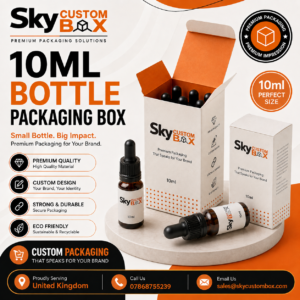

Small-format products are becoming increasingly important across the beauty, wellness, fragrance, pharmaceutical, and retail industries. Although a 10ml bottle may contain only a modest amount of product, its packaging has several important responsibilities. It must protect the bottle during handling and transportation, communicate essential information, support brand presentation, and provide a practical customer experience.
This is why choosing an appropriate 10ml bottle box requires more consideration than simply selecting a container that fits the bottle. Dimensions, material, structural design, printing, inserts, sustainability, and regulatory information can all influence the final packaging solution.
For brands developing small-format products, understanding these factors can help reduce packaging problems while creating a more consistent presentation across retail and online channels.
Why 10ml Bottle Packaging Requires Careful Planning
A 10ml bottle is commonly used for products such as essential oils, perfumes, serums, cosmetics, samples, concentrates, travel-size products, and other specialty formulations. These products can have very different packaging requirements depending on their bottle shape, closure, contents, and distribution method.
The relatively small size of the bottle creates a particular challenge: there is limited surface area for information, while the packaging still needs to provide sufficient protection.
A well-designed box can serve several purposes at once:
- Protect the bottle from scratches, impacts, and movement.
- Reduce the risk of breakage during transportation.
- Provide space for product and brand information.
- Create a consistent retail presentation.
- Support tamper-evident or security requirements where appropriate.
- Make small products easier to organize and display.
- Help maintain a recognizable visual identity.
For online retailers, protective packaging becomes especially important because products may pass through several stages of storage, picking, packing, transportation, and delivery before reaching the customer.
Choosing the Right Structure for a 10ml Bottle Box
The physical structure of the packaging should be determined by the bottle rather than by a generic box size. A bottle that fits too tightly may be difficult to insert or remove, while excessive internal space can allow movement and increase the likelihood of damage.
Before finalizing a packaging design, brands should measure more than the bottle’s height and width. Important dimensions can include:
- Bottle height
- Bottle diameter or width
- Cap or dropper dimensions
- Shoulder shape
- Closure height
- Label placement
- Required internal clearance
An internal insert can provide additional stability. Depending on the product, inserts may be made from paperboard, molded pulp, foam, or other suitable materials.
For lightweight retail products, folding carton construction is often practical because it can combine structural support with printed branding. Products requiring additional protection may need a stronger board grade or a more secure internal fit.
The packaging should also be tested with the actual bottle rather than relying entirely on digital dimensions. Minor differences in bottle manufacturing can affect the fit, particularly when packaging is produced at scale.
Materials and Sustainability Considerations
Packaging material selection increasingly involves a balance between protection, appearance, cost, and environmental considerations.
Paperboard and carton packaging are widely used for small bottles because they can be printed, folded into compact structures, and designed for efficient storage. Recyclability, however, depends on the specific materials, coatings, adhesives, inks, and waste-management infrastructure involved.
Brands evaluating sustainable packaging should consider the entire packaging system rather than focusing on one material characteristic.
Useful questions include:
- Is the box appropriately sized for the product?
- Can unnecessary layers or components be removed?
- Is the primary packaging compatible with the outer packaging?
- Can the materials be separated for recycling?
- Are coatings or finishes necessary for the intended application?
- Can responsibly sourced paperboard be used?
- Is the packaging durable enough to prevent product loss?
Reducing excessive empty space can also have practical environmental benefits. A compact package may require less material and can potentially improve shipping efficiency by allowing more products to occupy the same transport volume.
However, reducing material should never compromise protection. If fragile bottles arrive damaged, the environmental and financial costs associated with replacement products and additional transportation can outweigh the benefits of using less packaging.
Printing, Branding, and Product Information
A small bottle often provides limited room for communication. The outer box therefore becomes an important information surface.
Depending on the product category and applicable requirements, packaging may need to communicate information such as:
- Product name
- Net quantity
- Ingredients or formulation information
- Directions for use
- Warnings or precautions
- Batch or lot information
- Manufacturer or responsible business details
- Barcode
- Recycling information
- Contact or website details
The available space should be planned before the artwork is finalized. Typography that looks readable on a large package may become difficult to read on a compact 10ml product.
Good packaging design creates a clear hierarchy. The most important information should be easy to identify, while secondary information can occupy less prominent areas.
Brand identity is also important. Consistent typography, logos, imagery, colors, and finishing choices can help a small product appear connected to a broader product range.
For example, a skincare company may use the same visual system across 10ml serums, 30ml bottles, and larger retail products. This creates consistency without requiring every package to have exactly the same dimensions.
Common Packaging Challenges and Practical Solutions
Small bottle packaging can present several recurring problems. Identifying them early can reduce redesigns and production waste.
1. Poor Internal Fit
If the bottle moves excessively inside the box, it can experience impact during transportation.
Solution: Use accurate bottle measurements and consider an insert or locking structure where necessary.
2. Packaging That Is Too Tight
A box that fits the bottle too closely may create problems during packing and removal.
Solution: Allow appropriate tolerances based on the bottle material, shape, and manufacturing variation.
3. Excessive Packaging
Oversized boxes can increase material consumption, storage requirements, and shipping volume.
Solution: Develop packaging around the actual product dimensions while maintaining sufficient protective clearance.
4. Difficult-to-Read Information
Small packaging often results in crowded artwork.
Solution: Prioritize information and establish a clear visual hierarchy before printing.
5. Inconsistent Packaging Across Product Ranges
When different product sizes use unrelated packaging styles, customers may struggle to recognize the relationship between products.
Solution: Establish a consistent packaging system with adaptable dimensions and common design elements.
6. Insufficient Testing
A package may look correct on screen but perform differently in real-world handling.
Solution: Produce prototypes and conduct practical checks, including fitting, opening, closing, stacking, and transportation tests.
How 10ml Boxes Support Different Industries
The versatility of small bottle packaging makes it relevant to several industries.
Beauty and skincare: Small boxes can be used for serums, facial oils, treatments, and sample-size products.
Fragrance: Travel-size perfumes and fragrance samples often require packaging that balances presentation with protection.
Wellness: Essential oils and similar products may require compact packaging that provides product information and keeps the bottle secure.
Retail samples: Brands can use small-format packaging for promotional samples, trial products, or introductory product ranges.
Specialty products: Small-volume liquids, concentrates, and other niche products can benefit from packaging designed specifically around their bottle dimensions.
The appropriate design varies according to the product, sales channel, regulations, and expected handling conditions.
Practical Checklist Before Packaging Production
Before approving a packaging design, brands can use a simple checklist:
- Confirm the exact bottle dimensions.
- Measure the closure and any protruding components.
- Determine whether an insert is necessary.
- Select a suitable board or packaging material.
- Check the required product information.
- Confirm barcode readability.
- Review artwork at actual print size.
- Consider storage and transportation conditions.
- Create a physical prototype.
- Test the package with the actual product.
- Review sustainability and disposal considerations.
- Confirm that the design can be manufactured consistently.
Companies exploring customized packaging solutions may examine providers such as Sky Custom Box to understand how specialized box structures can be developed for different product dimensions and retail requirements.
Final Takeaway
A small bottle does not necessarily require a simple packaging strategy. The right box must balance protection, fit, information, usability, appearance, manufacturing requirements, and sustainability.
For brands working with 10ml products, the most effective approach is to begin with the physical characteristics of the bottle and then build the packaging structure around those requirements. Accurate measurements, suitable materials, thoughtful artwork, appropriate internal support, and real-world testing can make a significant difference to packaging performance.
Ultimately, a 10ml bottle box should do more than hold a small container. It should help protect the product throughout its journey, communicate useful information clearly, and fit naturally into the brand’s wider packaging system. By treating small-format packaging as a practical product-design decision rather than simply a decorative element, brands can create solutions that are more functional, consistent, and suitable for modern retail environments.